Pipe size chart
Updated 2026-10-18 · 8 min read
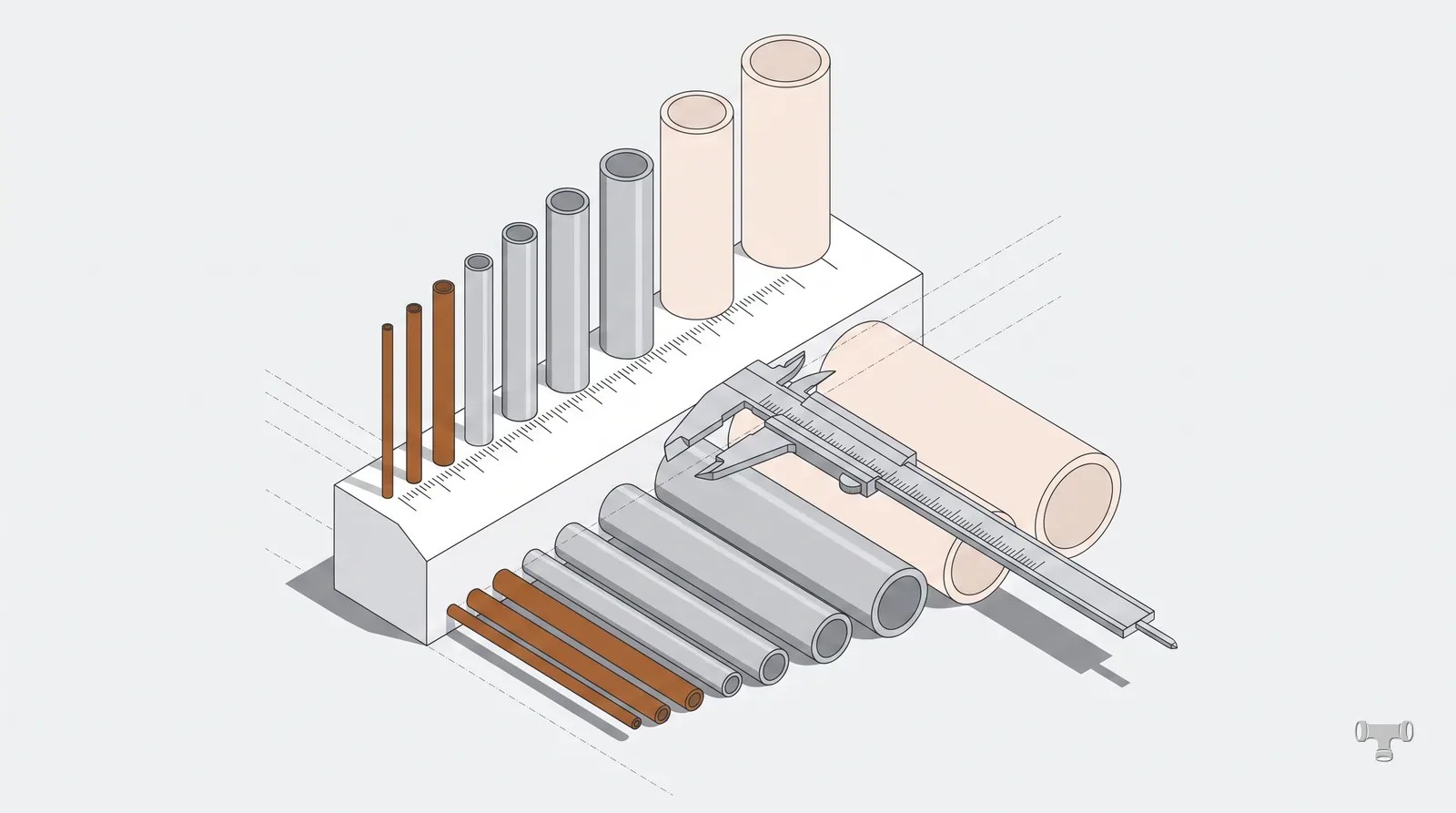
Why nominal is not measured
Nominal size is a name, not a dimension. It was a dimension once — in wrought iron the nominal number was roughly the bore — and when wall thicknesses changed the outside diameter was frozen so that threads and fittings would keep working. Everything since has inherited that frozen number.
So a 3/4" copper tube measures 0.875" across the outside, a 3/4" steel pipe measures 1.050", and neither of them has a 0.75" anything. Put a caliper on a line and you are measuring the outside diameter; the nominal name is a lookup away.
Copper is CTS, steel is IPS
Copper: K, L and M
All three types share an outside diameter and differ only in wall thickness. K is the thickest and goes underground, L is the residential standard above ground, M is the thinnest and is restricted or banned for pressure work in some jurisdictions. Thicker wall means smaller bore, which means less flow at the same nominal size.
| Nominal | OD | Type K ID | Type L ID | Type M ID |
|---|---|---|---|---|
| 1/2" | 0.625 | 0.527 | 0.545 | 0.569 |
| 3/4" | 0.875 | 0.745 | 0.785 | 0.811 |
| 1" | 1.125 | 0.995 | 1.025 | 1.055 |
| 1-1/4" | 1.375 | 1.245 | 1.265 | 1.291 |
| 1-1/2" | 1.625 | 1.481 | 1.505 | 1.527 |
| 2" | 2.125 | 1.959 | 1.985 | 2.009 |
The spread between K and M at 3/4" is 0.066" of bore. That sounds trivial and is worth roughly a fifth of the flow at the same pressure drop.
PEX, CPVC and PVC
PEX to ASTM F876 is copper tube size on the outside with a wall thickness set by SDR 9, which leaves noticeably less bore than copper of the same name. CPVC to ASTM D2846 is CTS at SDR 11 and sits between the two. PVC drainage pipe is IPS and much larger across for the same nominal number, which is why it never gets confused with supply.
| Nominal | PEX ID | CPVC ID | PVC sch 40 ID |
|---|---|---|---|
| 1/2" | 0.475 | 0.489 | 0.622 |
| 3/4" | 0.671 | 0.715 | 0.824 |
| 1" | 0.862 | 0.921 | 1.049 |
| 1-1/4" | 1.054 | 1.125 | 1.380 |
| 1-1/2" | 1.243 | 1.329 | 1.610 |
| 2" | 1.629 | 1.739 | 2.067 |
This is the repipe trap
Schedule 40 steel
Steel is IPS: the outside diameter is fixed per nominal size and the schedule number sets the wall. Schedule 40 is the residential gas standard. Because the OD is larger than copper for the same name, a 3/4" steel pipe has more bore than 3/4" copper — the opposite of the plastic comparison.
| Nominal | OD | Wall | ID |
|---|---|---|---|
| 1/2" | 0.840 | 0.109 | 0.622 |
| 3/4" | 1.050 | 0.113 | 0.824 |
| 1" | 1.315 | 0.133 | 1.049 |
| 1-1/4" | 1.660 | 0.140 | 1.380 |
| 1-1/2" | 1.900 | 0.145 | 1.610 |
| 2" | 2.375 | 0.154 | 2.067 |
What the inside diameter costs you
Flow at a fixed pressure drop scales close to the bore raised to the power of about 2.6 in the Hazen-Williams form the sizing tables use. That is why the tables never treat nominal sizes as interchangeable across materials, and why the honest way to compare two pipes is to compare their bores, not their names.
Keep this chart where you size, not where you buy. The mistake it prevents is not choosing the wrong pipe — it is assuming that a size written on a drawing means the same thing in whatever material ends up on the truck.