Skip to content
Sizing, slope and code, dimensionedAll tools free

PEX vs copper

Updated 2026-09-04

Two materials, both approved, both routinely specified for the same job. The honest comparison is not which is better but which failure mode you would rather own, and what the bore difference does to your sizing once you have chosen.

Best overall

PEX-A on a home run

Fewer joints inside walls, a third less labour, and it survives a freeze more often than it splits.

Best value

PEX-A

Roughly half the material cost and a third fewer hours per fixture at the same code compliance.

Best for repipes

PEX-A, re-sized

It fishes through existing framing — but re-size the trunk, because the bore is smaller for the same nominal name.

Sizing and flow
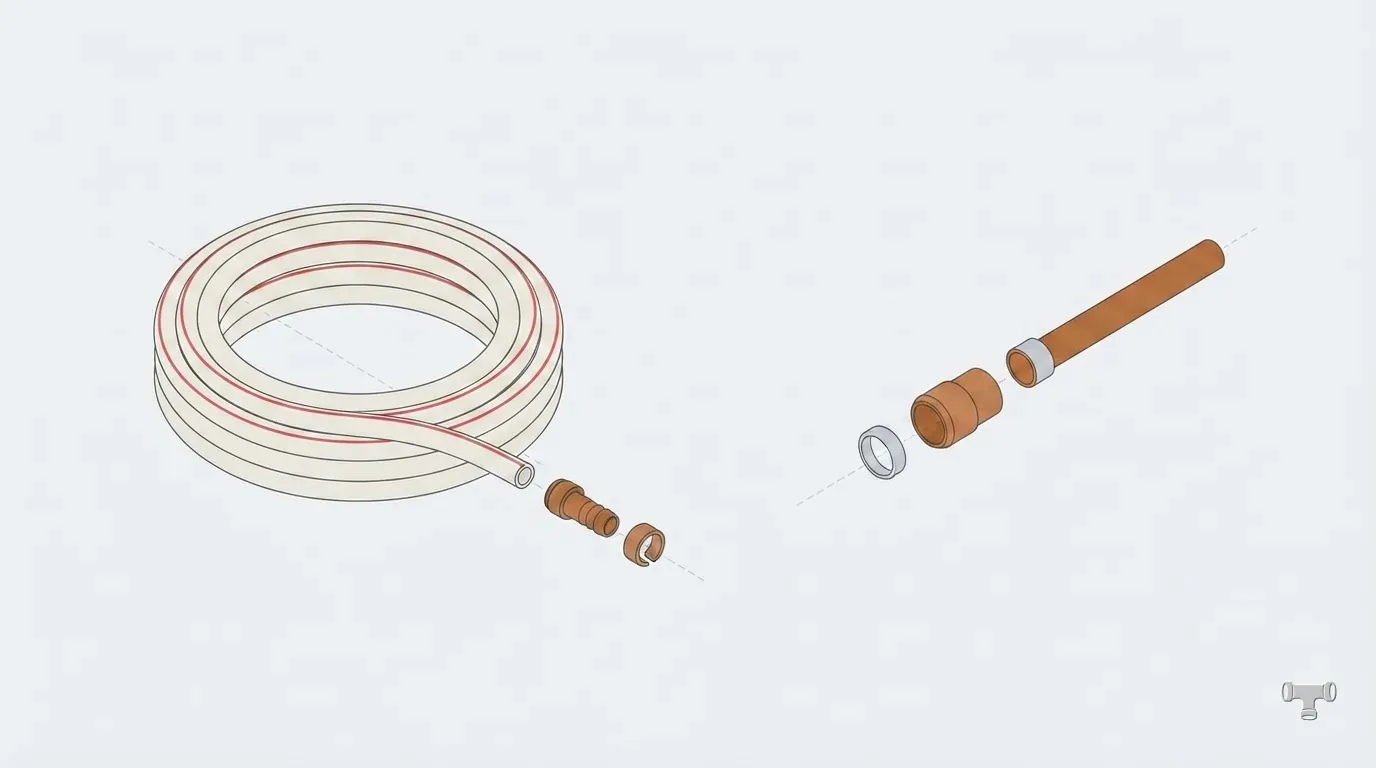
Isometric illustration comparing a PEX crimp joint and a soldered copper joint
A PEX coil with a crimp ring beside a copper stub with a solder ring.

The matrix

Material and labour ranges read from national supplier listings, 2026-09-04
FactorPEX-ACopper type L
Material cost per fixture$55–130$130–300
Labour hours per fixture2.0–3.23.4–5.4
Inside diameter, 3/4"0.671"0.785"
Joints in a wallHome run: noneOne per direction change
Freeze behaviourExpands, often survivesSplits
UV toleranceNone — must not be exposedUnaffected
Service life claimManufacturer 25+ yr warranty50+ yr in service
Recyclable at end of lifeNo practical streamYes, with scrap value
Repair by a future ownerNeeds the right toolTorch and fittings

The bore is the trap

Three-quarter inch PEX has about 15 percent less bore than three-quarter inch copper. Swapping material at the same nominal size costs you flow at the far fixture. Re-run the pipe size calculator when the material changes — that is the whole reason it has a material selector.

Where each one wins

PEX-AASTM F876

Home runs from a manifold mean no joints inside a wall, which removes the failure mode that matters most in a finished house. It fishes through existing framing, it tolerates a freeze far better than copper, and it cuts the labour line by roughly a third.

Against it: no UV tolerance at all, a smaller bore for the same name, rodent damage is a real phenomenon in some regions, and a future owner needs the right expansion tool to touch it.

Copper type LASTM B88

Fifty years of service history, immune to UV and rodents, larger bore for the same nominal size, and it can be worked by anyone with a torch. It is the material that still gets specified where the wall will never be opened again.

Against it: roughly double the material and a third more labour, it splits when it freezes, and it is sensitive to aggressive water chemistry — pinholes are a real failure mode in some water systems.

What the water does to each

Copper's failure mode is chemical. Low pH, high velocity or stray electrical current produce pinhole pitting, and where a neighbourhood has that problem it has it on every copper system in it. Ask locally before specifying copper in an unfamiliar area; the local plumbers will know immediately.

PEX's failure modes are mechanical and environmental: UV exposure during storage or an unfinished build, a fitting crimped badly, and chlorine dioxide at high temperature over many years. All three are avoidable and all three are installer-controlled.

Sizing and flow
Isometric illustration comparing a PEX crimp joint and a soldered copper joint
A PEX crimp joint beside a soldered copper joint.

Buying checklist

Before you commit the material

  • Confirm both materials are approved for potable supply by your AHJ.
  • Re-size the trunk for the material you actually chose, not the one you priced.
  • For PEX: manifold location decided, no UV exposure on site, correct tool on the van.
  • For copper: local water chemistry checked with someone who works in that area.
  • Either way: nail plates wherever pipe passes within 1-1/4" of a stud face.