Skip to content
Sizing, slope and code, dimensionedAll tools free

Tank vs tankless water heater

Updated 2026-09-04

The decision is not about hot water. Both deliver it. It is about whether the house has simultaneous demand or sequential demand, whether the gas line and the vent can serve a unit that draws four times the input, and what the customer is actually buying with the install premium.

Best overall

Tank, for most houses

It meets simultaneous demand at any flow, and the existing gas and vent usually serve it without a project.

Best value

Tank replacement

Half the install hours, no gas upsize, no new vent — the cheapest route to reliable hot water.

Best for endless supply

Gas tankless, sized at your rise

Sequential demand, a long service life and reclaimed floor space — provided the gas and vent are budgeted honestly.

Costs and estimating
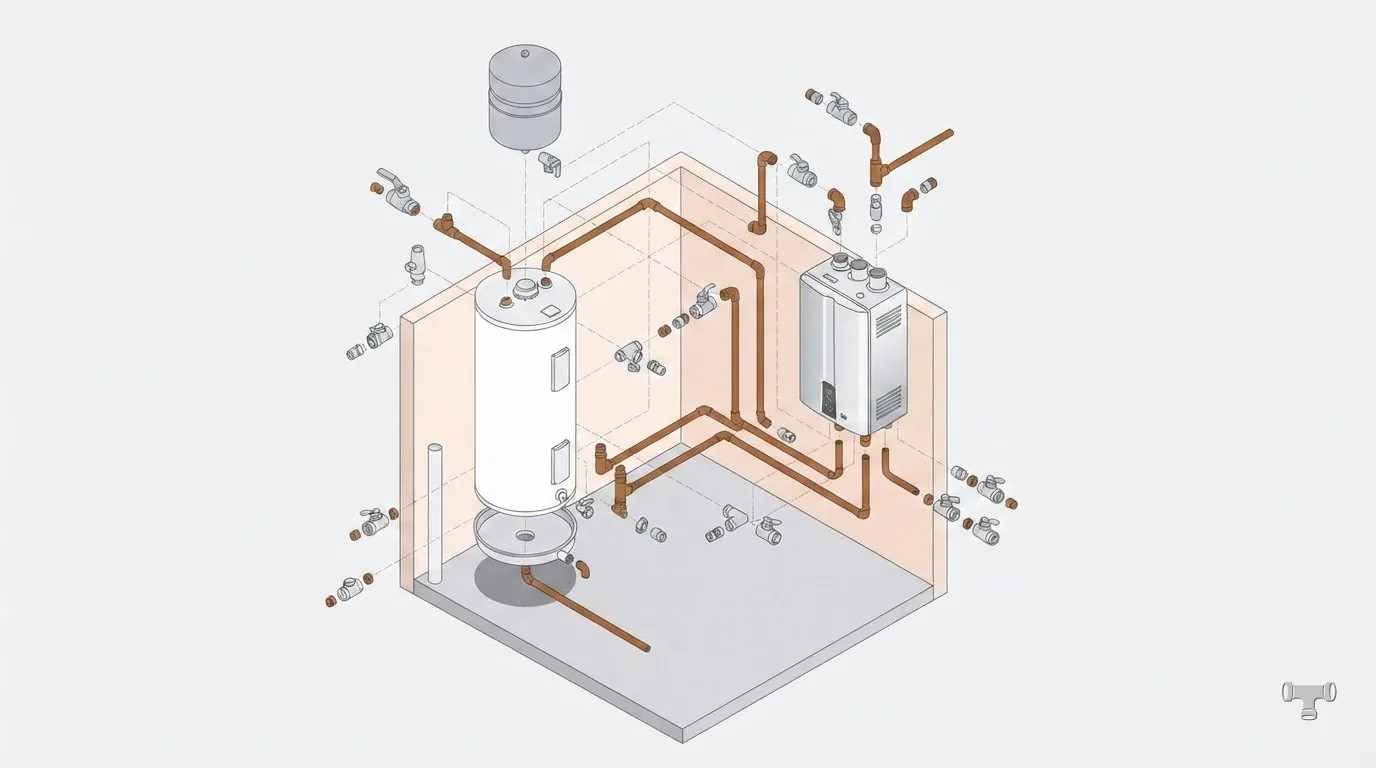
Isometric illustration comparing a tank and a tankless water heater
A tank heater and a wall-hung tankless side by side, connections exploded apart.

The matrix

Unit and hours ranges read from national supplier listings and trade material, 2026-09-04
FactorTankTankless
Unit cost$550–1,500$900–2,400
Install hours2.5–56–18
Gas input~40,000 BTU/h150,000–199,000 BTU/h
Usually needs a gas upsizeNoOften
VentExisting flue often reusedNew PVC or stainless run
Hot waterLimited by tank and recoveryContinuous, limited by GPM
Simultaneous demandWhole tank at onceCapped by flow at your rise
Standby lossYes, small on a modern unitNone
Service life10–12 years~20 years
Annual maintenanceFlush, anode checkDescale, filter clean
FootprintA cupboardA wall

Where each one wins

TankStorage

It delivers its whole capacity at once regardless of flow rate, which is what a house with two simultaneous showers actually needs. The replacement is a half-day, the parts are everywhere, and the existing gas and vent almost always serve it.

Against it: it heats water nobody used, it takes floor space, and it ends its life in about a decade — usually by leaking onto whatever is underneath it.

TanklessOn demand

Endless hot water, twenty years of service life, no standby loss and a wall instead of a cupboard. On a house with sequential rather than simultaneous demand it simply never runs out.

Against it: the install premium is real and sometimes large, the flow cap is a hard limit at your climate's temperature rise, and descaling is not optional on hard water.

The rise is the whole specification

A unit rated 9 gpm at a 35 °F rise delivers around 4 gpm at 75 °F. Two showers at 2 gpm is a genuine 4 gpm requirement at your rise. Work it out on the sizing calculator before anyone quotes a model.

The payback claim, examined

The energy saving is standby loss, and on a modern well-insulated tank that is a modest number. Against an install premium that routinely runs one to three thousand dollars, simple payback on energy alone frequently exceeds the unit's warranty period.

Sell the real advantages — endless supply, longer life, reclaimed space — and let the energy line be a bonus rather than the argument. A payback figure nobody measured is the claim that comes back in a review.

Costs and estimating
Isometric illustration comparing a tank and a tankless water heater
A tank unit and a wall-hung tankless, both with connections exploded apart.

Buying checklist

Before the model is chosen

  • Peak-hour demand computed, not guessed — gallons for a tank, GPM for a tankless.
  • Coldest incoming water temperature established; flow read at that rise.
  • Gas line checked against the new connected load on the longest run.
  • Vent path identified through a real wall, with condensate handled.
  • Expansion control confirmed — required on a closed system either way.
  • Descaling interval agreed and priced into the comparison.