Skip to content
Sizing, slope and code, dimensionedAll tools free

ABS vs PVC for DWV

Updated 2026-09-04

Two approved drainage materials that do the same job at the same sizes. The choice is decided by what your jurisdiction is used to, what the building already has in it, and how cold it is on the day you are gluing.

Best overall

PVC, in most markets

Stiffer, quieter, stocked everywhere, and the primer step leaves visible evidence of joint preparation.

Best value

Whichever your supplier stocks

Neither carries a price advantage worth a special order. Matching local practice is the saving.

Best for cold work

ABS

One-step cement and better low-temperature toughness — which is exactly why northern markets standardised on it.

Code and permits
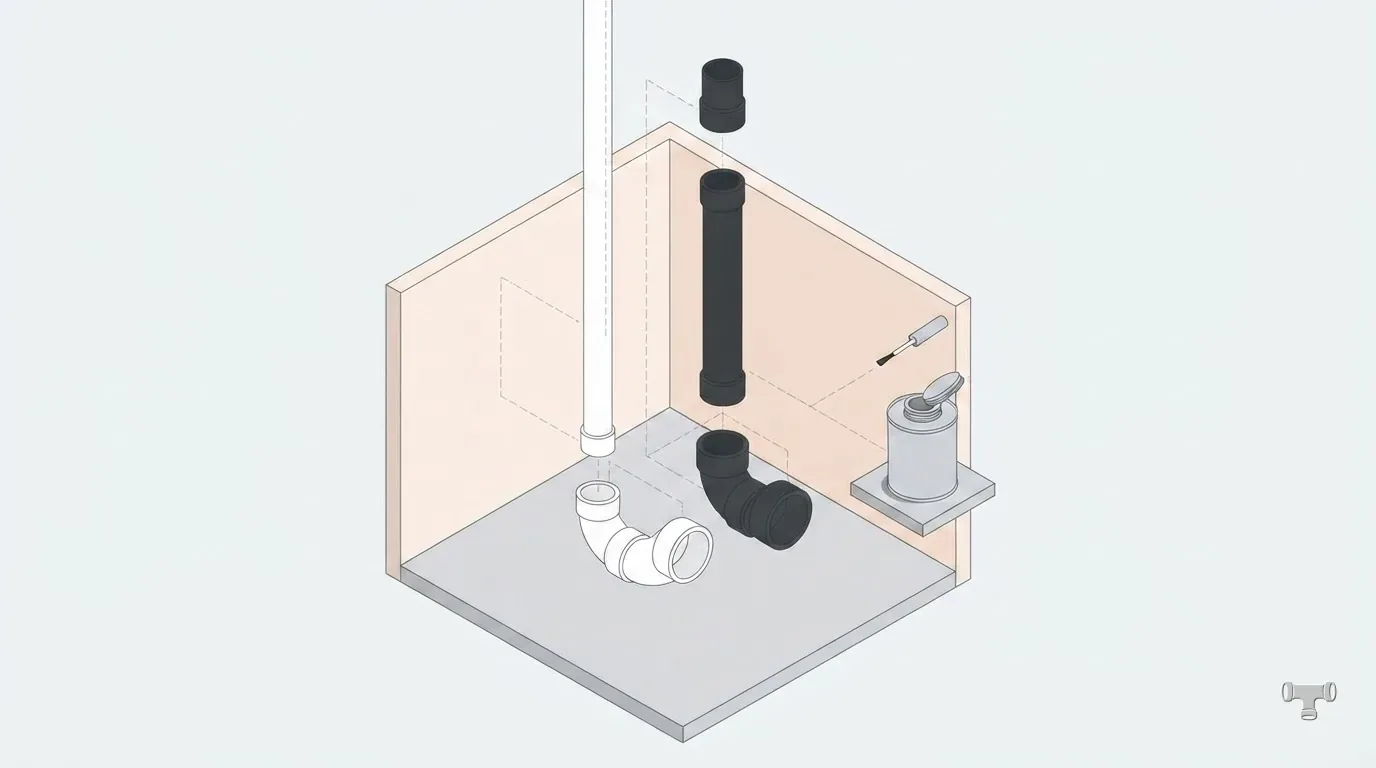
Isometric illustration comparing an ABS and a PVC drainage elbow
A black ABS elbow and a white PVC elbow with a cement can and a length of each.

The matrix

Both are approved DWV materials in most jurisdictions; local practice and amendments decide.
FactorABSPVC
StandardASTM D2661ASTM D2665
ColourBlackWhite
JoiningOne-step cementPrimer, then cement
Joint time in coldSets fast, workable coldPrimer sluggish below ~40 °F
Impact resistance in coldBetterBecomes brittle
RigidityMore flexibleStiffer, sags less between hangers
Sound transmissionNoisierSlightly quieter
UV tolerancePoor — must be painted if exposedPoor — must be painted if exposed
Regional availabilityCommon in parts of the west and northCommon nearly everywhere

Code violation

Do not cement ABS to PVC. Transition cements exist and several jurisdictions prohibit the joint outright; where a transition is unavoidable, use a mechanical coupling with a shielded band, not a solvent joint.

Where each one wins

ABSD2661

One-step cement means no primer, which is genuinely faster in a crawlspace and far more forgiving in the cold. It stays tougher at low temperature, which is why it dominates in several northern and western markets.

Against it: more flexible, so it wants closer support; noisier under a bedroom floor; and in markets where nobody stocks it, sourcing a fitting on a Saturday is a problem.

PVCD2665

Stiffer, quieter, and stocked everywhere in every fitting configuration. The primer step is a nuisance but it is also visible evidence at inspection that the joint was prepared, which some inspectors specifically look for.

Against it: two-step joining takes longer, and both the primer and the pipe are unhappy in genuine cold — below about 40 °F the primer flashes slowly and the pipe chips rather than cuts.

Neither choice changes the sizing

Both are iron pipe size and both carry the same bore at the same nominal size, so slope, drain size and trap arm limits are identical either way. IPC Table 704.1 sets 1/8" per foot for a 3" line in ABS exactly as it does in PVC.

What does change is the support interval and the expansion allowance, both of which the manufacturer publishes and both of which are stricter for ABS. Read those before you set hangers.

Code and permits
Isometric illustration comparing an ABS and a PVC drainage elbow
A black ABS elbow and a white PVC elbow side by side with a cement can.

Buying checklist

Before the truck is loaded

  • Which material is approved and which is customary with your AHJ.
  • Match what is already in the building where you are extending it.
  • Cement and primer rated for the pipe, in date, and stored above freezing.
  • Support interval taken from the manufacturer, not from habit.
  • Any exposed run gets painted — both materials fail in UV.
  • No solvent transition between the two. Mechanical coupling or nothing.